
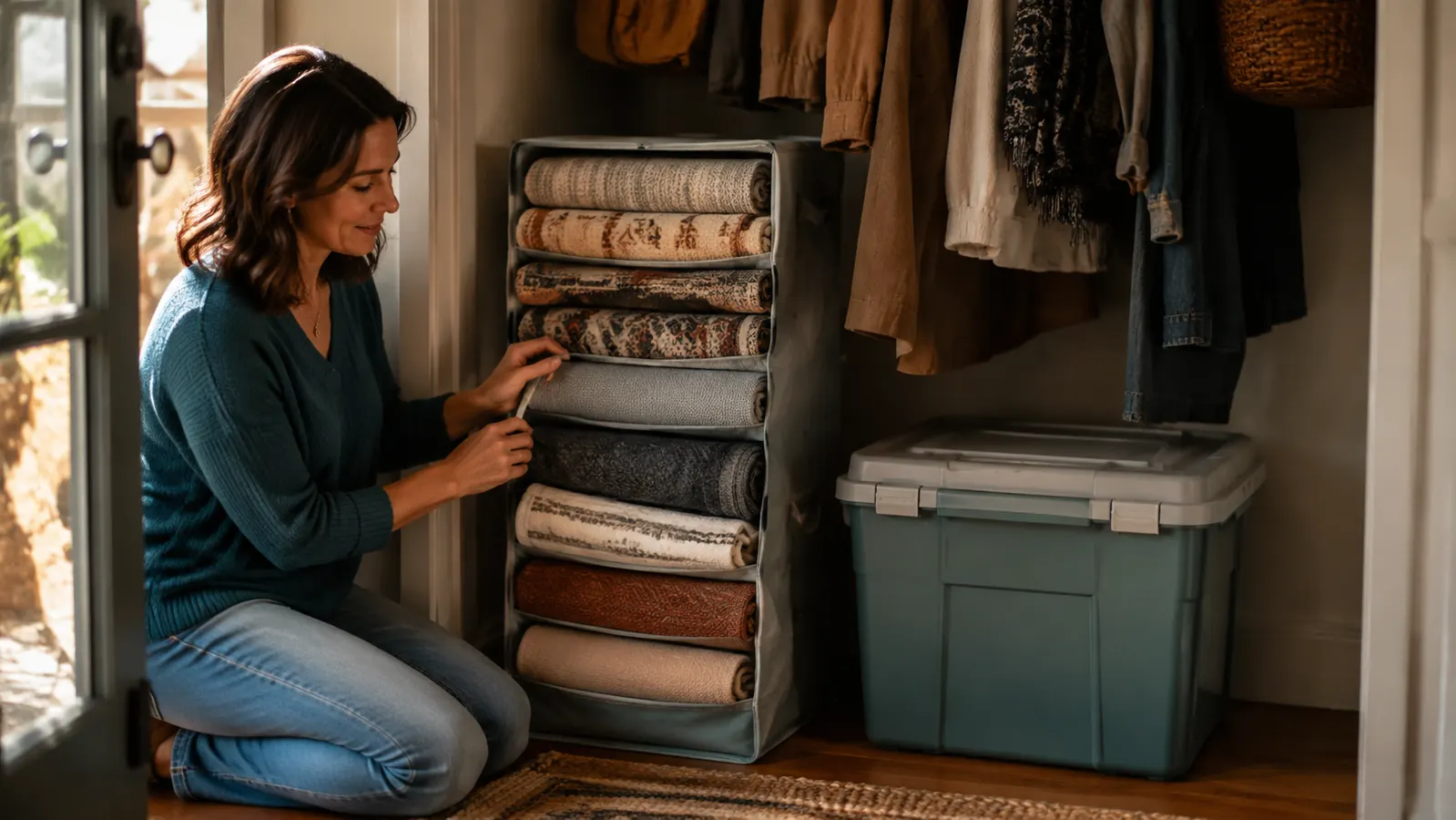
Short answer, if you only have room for one closet shelf and you want to grab everything in a single trip to the wrapping station, the Homior organizer wins. If you're storing wrap in a garage, attic, or basement where humidity and mice are real concerns, the Rubbermaid Wrap N' Craft bin earns its keep instead.
I tested both in my own house this past holiday season, the Homior in my upstairs hall closet next to the linens, and a Rubbermaid Wrap N' Craft bin a friend loaned me so I could compare it in my garage. Neither one is a bad product. They're just built for different rooms, and the wrong pick costs you either floor space or torn paper by February.
How I Tested Both
I loaded each one with the same stack of wrapping paper rolls, twenty-two rolls total, plus two spools of ribbon, a bag of gift tags, and a roll of tissue paper I never seem to use until the last minute. Then I lived with both for six weeks, from the first Black Friday gift wrapping session through the last late-night wrap job on December 23rd.
The Homior is a soft-sided fabric organizer that stands upright or hangs on a closet rod, with individual roll pockets down the front and a zippered top pocket for ribbon and tags. The Rubbermaid Wrap N' Craft is a rigid plastic tote with a hinged or lift-off lid, built more like a storage bin than a garment bag, and it's designed to be stacked or slid under a shelf rather than hung.
Both claim to fit standard 40-inch wrapping paper rolls without forcing you to fold or crease the paper. Both delivered on that promise, though they get there in very different ways, which is where the real differences start to show up.
Setup told me something too. The Homior arrived flat in a box, unzipped itself into shape in about a minute, and stood up on its own the second I slid the first few rolls in. The Rubbermaid bin needed no assembly at all, but the lid took some getting used to. On the version I tested, the latch clips were stiff enough that I had to set the bin down and use both hands, which is a small thing until you're juggling it one-handed while holding a roll of paper in the other.
| Homior Fabric Organizer | Rubbermaid Wrap N' Craft | |
|---|---|---|
| Typical price | Around $20 | Closer to $35 |
| Roll capacity | Up to 27 rolls | Around 25 to 30 rolls |
| Material | Tear-resistant fabric with reinforced handles | Rigid injection-molded plastic |
| Storage style | Stands upright or hangs on a closet rod | Sits flat, stacks like a storage tote |
| Closet footprint | About the width of a rolled beach towel | About the width of a large duffel bag, always flat |
| Portability | Two carry handles, folds flatter when partly empty | No built-in handles on most versions, heavier to lift full |
| Moisture and pest resistance | Fabric can absorb dampness, no seal | Sealed lid resists moisture and bugs |
| Extra compartments | Mesh and zippered pockets for ribbon, bows, tags | Small side compartments, varies by version |
| Best storage location | Bedroom or hall closet | Garage, attic, or basement |
Where the Homior Wins
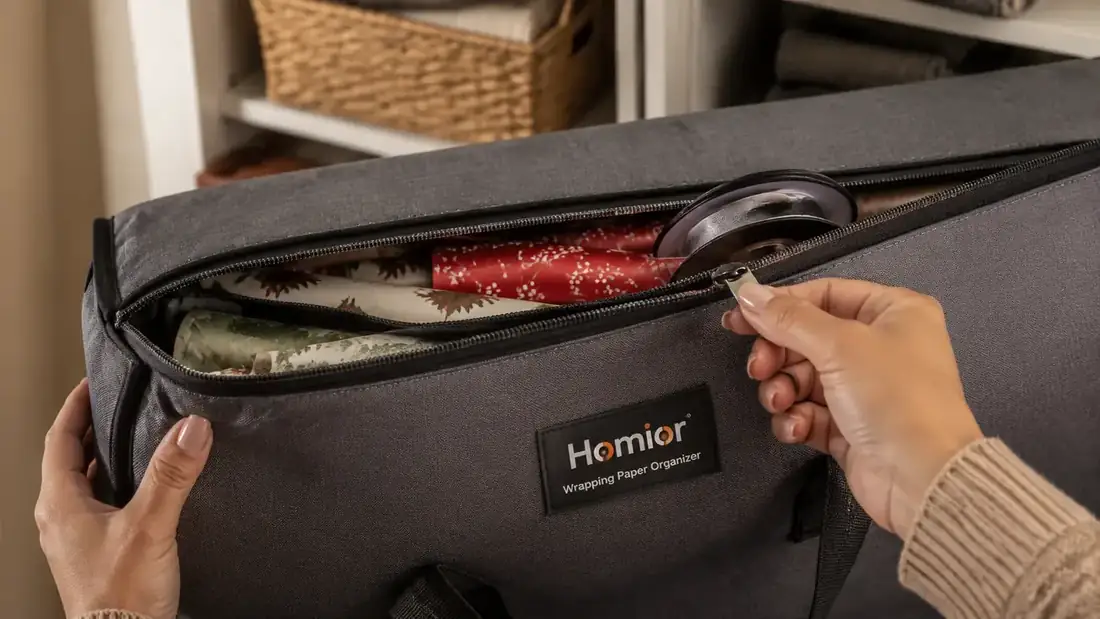
The Homior wins on footprint, and in a house without a dedicated craft room, footprint is everything. It stands on its own in the corner of my hall closet, about six inches wide when it's full, and it never once fell over into my winter coats the way a floppy bag would. When I needed to grab a roll of paper for a last-minute birthday, I unzipped one pocket and pulled it out without disturbing anything else. The Rubbermaid tote, by comparison, sits flat and takes up an entire shelf, so if that shelf also holds anything else, you're moving boxes to get to your wrap.
It also wins on price and on how it behaves as it empties out. A hard plastic bin is the same size in June, half full, as it is in December, packed. The Homior collapses down as you use up rolls, so by March it's a thin, easy-to-tuck-away pouch instead of a bulky empty container hogging shelf space eleven months out of the year. For anyone storing wrap in a bedroom or hall closet where every inch matters, that alone tips the scale.
Ribbon, Bows, and Gift Tags
This is where the gap widened the most for me. The Homior has a zippered mesh pocket up top plus smaller slip pockets down one side, so my ribbon spools, a pack of gift tags, and a roll of curling ribbon each had their own spot. I could see through the mesh which spool was which without unzipping anything. The Rubbermaid Wrap N' Craft has a small side compartment on some versions, but on the one I tested it was one open bin, so ribbon, bows, and loose tags all migrated into a single tangled pile by week three. If small accessories matter as much to you as the paper itself, that's a real point in the Homior's favor.
Where the Rubbermaid Wrap N' Craft Wins
Give the Rubbermaid its due where it's actually stronger. It's a sealed, rigid container, which matters a lot if you're storing wrapping paper anywhere other than climate-controlled bedroom closet space. My garage gets humid in July and cold enough to sweat in January, and a hard plastic tote with a snapped-down lid keeps that moisture, plus any curious mice, away from paper goods in a way soft fabric simply can't. If your storage spot is a garage shelf, an attic, or a basement, this is the more honest choice.
It also stacks. If you're the kind of household that stores wrap for every holiday year-round, not just Christmas, you can stack a Rubbermaid Wrap N' Craft bin under or beside other totes on a garage shelving unit and the shape stays predictable. A fabric organizer doesn't stack the same way, it needs to hang or stand, which limits it to closet-style storage rather than warehouse-style shelving.
Closet space is the real cost, not the sticker price.
If your wrapping paper lives anywhere near your bedroom or hallway, the Homior organizer earns back its footprint in a single holiday season. See today's price and roll capacity on Amazon.
Amazon Check Today's Price on Amazon →I also noticed a difference in how each one handled the mid-season chaos of actually wrapping gifts. With the Homior standing in the closet, I could unzip it, pull one roll partway out to check the pattern against a gift, and zip it back up without unloading anything else. With the Rubbermaid bin, every roll on top had to come out before I could see what was underneath, because the rolls sit loose rather than in individual sleeves.
Capacity and Weight, By the Numbers
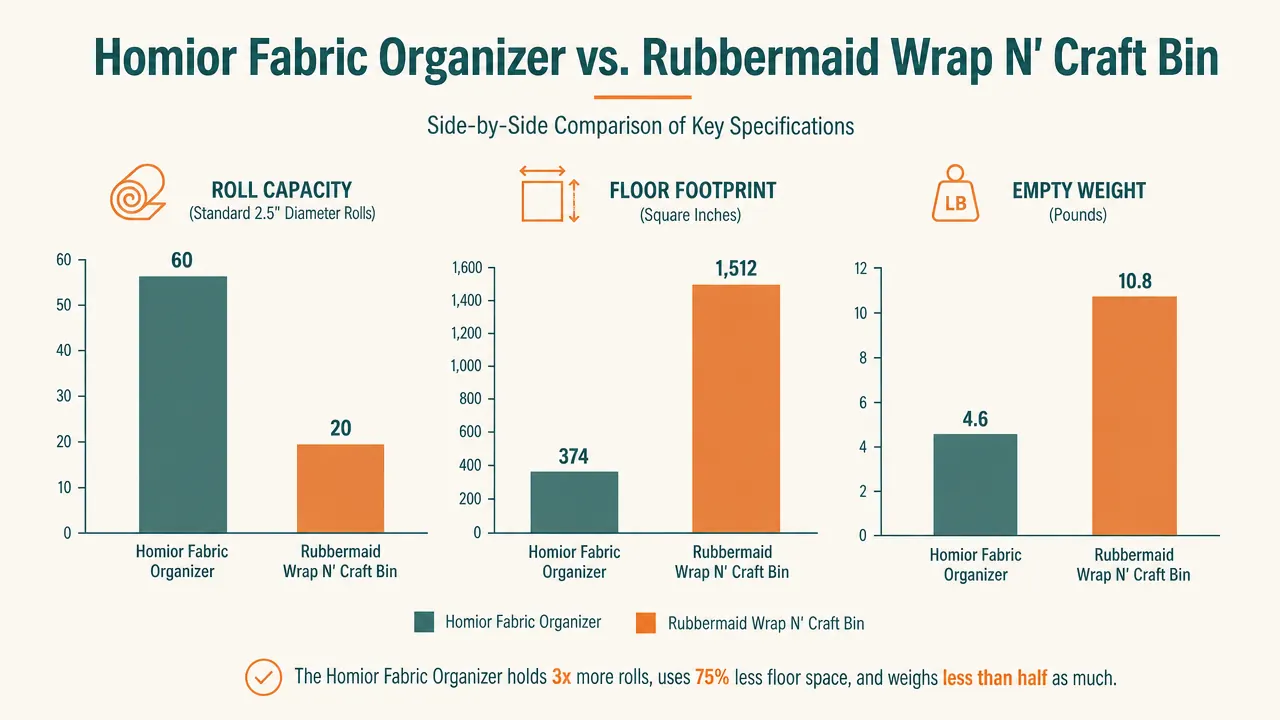
On paper, both hold a similar number of rolls, roughly the mid-twenties to high-twenties depending on roll thickness. In practice, the Homior's individual pockets meant I could actually use all 27 slots without paper sliding around or crushing against itself. The Rubbermaid bin's open interior meant thinner rolls tended to roll into gaps and get slightly dented by the heavier rolls stacked against them, especially after a few weeks of being opened and closed.
Weight matters more than people expect here too. Empty, the Homior weighs next to nothing and folds down small enough to stash on a top shelf in the off season. The Rubbermaid tote, even empty, is a rigid plastic shell that still takes up its full footprint whether it's holding two rolls or twenty-five, which is fine in a garage with dedicated shelving but wasteful in a bedroom closet.

Durability After Real Use, Not Just the First Week
Six weeks isn't a full year, but it was enough to catch how each one wears. The Homior's fabric is thick enough that my dog's tail brushing past it in the hallway never caught or snagged it, and the reinforced handles showed no fraying even after I carried it fully loaded from the closet to the living room a dozen times over the holidays. The zipper pulls stayed smooth the whole time, no sticking, no misaligned teeth.
The Rubbermaid bin held up fine structurally, plastic totes are hard to break, but the latch clips on the lid loosened slightly with repeated open-and-close cycles, enough that by the end of the six weeks the lid didn't always seat flush. Nothing spilled, but it's the kind of small wear pattern that makes me wonder how it holds up after five holiday seasons instead of one.
Who Should Buy Which
Buy the Homior if your wrapping paper lives in a bedroom closet, hall closet, or anywhere else where floor and shelf space is already tight. It's also the better pick if you wrap gifts year-round for birthdays, not just Christmas, since you'll be in and out of it constantly and the individual pockets make grabbing one roll fast. Buy the Rubbermaid Wrap N' Craft instead if your storage spot is a garage, attic, or basement where moisture, dust, or pests are a real concern, or if you already have a shelving system built around stackable totes and want your wrapping supplies to match that setup.
There's also a middle case worth naming, the household that stores most of the year's wrap in the garage but keeps a small everyday stash upstairs for birthdays and thank-you gifts. If that's you, there's nothing wrong with owning both, a Rubbermaid bin for the bulk of your Christmas rolls in the garage, and a Homior for the handful of rolls you actually reach for month to month. I ended up doing exactly that in my own house, and it's the only setup that's kept me from digging through a closet at 11pm looking for tape.
For most closets, the fabric organizer is the smarter buy.
Unless your wrap is stored in a garage or attic, the Homior's smaller footprint and individual roll pockets make it the easier one to live with. Check today's price and availability.
Amazon Check Today's Price on Amazon →